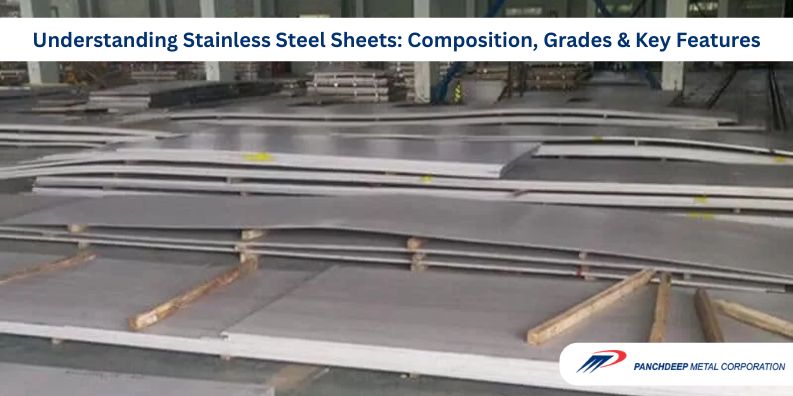
Stainless steel sheets are the most widely fabricated flat-rolled stainless product across construction, food processing, automotive, chemical, and medical sectors – yet grade selection errors and misidentified surface finish requirements cause preventable project failures every year.
The confusion is understandable. Multiple grades are in common industrial supply, each with different composition limits. Five standard surface finishes are in routine use. Hot-rolled and cold-rolled processes produce sheets with different mechanical properties from the same alloy. This guide covers the composition fundamentals, grade differences, and key performance characteristics that determine correct specification.
What Are Stainless Steel Sheets?
A stainless steel sheet is a flat-rolled product with a thickness generally up to 6 mm – above that threshold, the product is classified as a plate under most standards. The distinction matters for procurement: sheets and plates carry different thickness tolerances, flatness specifications, and standard cut sizes under ASTM A240/ASME SA240 and EN 10088-2 (European Norm).
To manufacture cold-rolled sheet, several roll stands refine the grain structure and tighten dimensional tolerances on the hot-rolled strip at ambient temperature. Food processing, ornamentation, and precision manufacturing benefit from its smooth surfaces. Scaled surface and wider tolerances make hot-rolled sheet appropriate for structural and non-critical use. 2B (bright cold rolled, gently skin-passed), BA (bright annealed), No. 4 (brushed, linear grain), and mirror polished have standardised roughnesses.
Chemical Composition of Stainless Steel Sheets
The defining compositional requirement is a minimum of 10.5% chromium by mass. At that concentration, chromium forms a self-repairing passive oxide layer that prevents further oxidation. Nickel additions stabilise the austenitic phase, improving ductility and weldability – Grade 304 carries 8–10.5% Ni; Grade 316 carries 10–14% Ni. Molybdenum at 2–3% in Grade 316 raises the pitting resistance equivalent number (PREN) from approximately 18 to 25, providing chloride corrosion resistance that 304 cannot deliver.
Carbon content governs sensitisation risk. In grades that don’t have the L designation, carbon forms chromium carbides at the edges of the grains during welding, which reduces the amount of chromium in the heat-affected zone (HAZ) and makes it more vulnerable to intergranular attack. The L grades, such as 304L, 316L, limit carbon to ≤0.03% C, preventing sensitisation without post-weld heat treatment (PWHT) in standard fabrication conditions.
Common Grades of Stainless Steel Sheets
Grade 304 Stainless Steel Sheet
Grade 304 (18% Cr, 8% Ni) is the standard specification for general fabrication, kitchen equipment, and architectural cladding in non-aggressive environments. Weldability is excellent without PWHT. The 304L variant (≤0.03% C) is specified wherever as-welded corrosion resistance in the HAZ is required.
Grade 316 Stainless Steel Sheet
Grade 316 adds 2–3% molybdenum to the 304 base, raising the PREN to approximately 25. Marine cladding, chemical plant panelling, and pharmaceutical processing surfaces specify 316 as the minimum grade. The 316L variant applies where weld sensitisation risk exists.
Grade 430 Stainless Steel Sheet
Grade 430 is a ferritic grade with 16–18% Cr and no intentional nickel addition. Corrosion resistance sits below 304, but the cost savings make it viable for interior architectural panels and appliance cladding where chloride contact is absent.
Duplex Grade Stainless Steel Sheets
Ferritic-austenitic Duplex 2205 has high chromium, molybdenum, and nitrogen content. Minimum yield strength is 450 MPa, double 304 annealed. Oil and gas topsides, desalination plant linings, and pressure vessel cladding require duplex sheet for load-bearing capability and chloride resistance.
Key Features of Stainless Steel Sheets
• Corrosion resistance: the self-healing passive film offers uninterrupted protection without the necessity for supplementary coatings under the majority of atmospheric and process conditions.
• Mechanical strength: austenitic grades develop 205 MPa minimum yield in the annealed condition; duplex grades reach 450 MPa minimum – both with good ductility and formability.
• Heat resistance: Grade 304 maintains its oxidation resistance up to 870°C under intermittent service, while Grade 310 maintains this up to 1100°C under continuous service.
• Fabrication and weldability: Conventional SMAW, GTAW, and GMAW processes can shape, bend, and weld L-grade cold-rolled sheets without preheating in ambient circumstances.
• Hygienic surface characteristics: 2B and No.4 finishes are recognised by FDA and EHEDG standards for food contact and pharmaceutical clean-room applications.
Applications of Stainless Steel Sheets
The following pointers detail the primary industrial applications for Stainless Steel Sheets:
- Construction & Architectural Cladding: This category represents the highest volume use; grades 304 and 316 are specified for building facades, column cladding, and interior feature walls.
- Kitchen & Food Processing: Fabrication of surfaces and equipment utilises 304L and 316L to maintain hygiene standards in as-welded conditions.
- Medical Equipment: Operating theater surfaces, instrument trays, and sterilisation cabinets specify 316L for resistance to chlorinated disinfectants.
- Chemical Processing: Vessels and tank panels use 316L and 317L to withstand acids and chloride-bearing process streams.
- Automotive Components: Ferritic grades 409 and 441 are standard for exhaust systems and heat shields.
- Decorative Interior Panels: Hotels and commercial fit-outs employ BA (bright annealed) and mirror-polished 304 sheets, which are types of stainless steel, where aesthetic finish is the primary technical driver.
Stainless Steel Sheets vs Other Materials
Against carbon steel: uncoated carbon steel corrodes in most outdoor and process environments without surface protection; stainless steel does not. The maintenance cost difference over a 25-year asset life consistently favours stainless despite the higher initial material cost.
Against aluminium: 304 delivers 205 MPa minimum yield against approximately 110 MPa for commercial aluminium alloys in the annealed condition, along with better surface wear resistance. Stainless steel is fully recyclable without degradation in material properties – relevant for projects with LEED certification requirements.
Standards and Specifications for Stainless Steel Sheets
The primary standards for stainless steel sheet supply are ASTM A240 (American Society for Testing and Materials – chromium and chromium-nickel stainless steel plate, sheet, and strip) and its ASME adoption, SA240, for code-stamped pressure equipment. EN 10088-2 governs flat-rolled products under the European Norm. Thickness tolerances, width tolerances, and surface finish requirements are defined within each standard, as a sheet specified by grade alone, without surface finish designation and standard reference, is incompletely specified. Mill test certificates to EN 10204 3.1 must accompany all structural and process-critical supplies.
How to Choose the Right Stainless Steel Sheet Supplier
Grade availability across standard and special grades, which is not only 304 and 316, determines whether a stainless steel sheet manufacturer can serve complex project requirements without forced grade substitutions. Quality documentation must include heat-level chemical and mechanical test reports. Custom cut-to-size capability reduces material waste on non-standard project dimensions. Any stainless steel sheet supplier serving export markets must demonstrate ASTM, ASME, and EN standard compliance on supply documentation.
Conclusion
Correct grade selection, composition verification, and surface finish specification determine whether stainless steel sheets deliver their intended corrosion resistance, strength, and service life. Operating environment, chloride exposure, fabrication method, and regulatory requirements must be evaluated before finalising the specification.
Panchdeep Metal, a certified supplier of stainless steel sheets, can provide EN 10204 3.1 mill test certificates, full heat traceability, and compliance documentation for structural, process, and export applications. Kindly submit your RFQ with details of grade, standard (ASTM A240 / EN 10088), finish, and size required.