Introduction
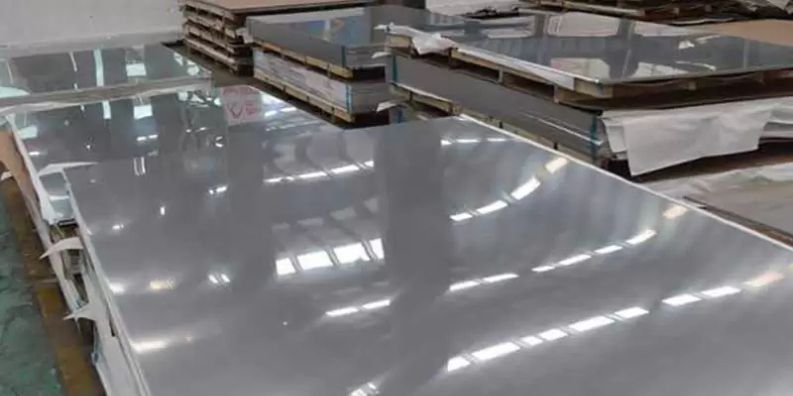
Stainless Steel 410S sheet is a ferritic grade that handles moderate corrosion, decent heat exposure, and welding without the complications that the standard 410 grade sometimes causes. It is the low-carbon version of 410 stainless steel. The reduced carbon content is what separates the two, and it makes a real difference in fabrication environments.
AISI 410S Sheets resist corrosion reasonably well, handle oxidation at elevated temperatures, and can be welded without the cracking concerns tied to higher-carbon grades. The grade is not positioned as a high-strength material. What it does well is stay dimensionally stable through thermal cycling, resist surface degradation, and hold up over long service periods with minimal maintenance.
What Are Stainless Steel 410S Sheets?
410S is a low-carbon ferritic stainless steel. Carbon is capped at 0.08%, which is the defining difference from standard 410. Lower carbon means reduced carbide precipitation at grain boundaries during welding. In practical terms, that means fewer weld failures and less post-weld cracking.
The ferritic microstructure stays stable through normal fabrication. It does not transform to martensite during processing, so hardness remains predictable. That matters when consistency across a large order is a requirement.
410S SS Sheets are used in the petrochemical processing, automotive manufacturing and heat treatment industries because the grade can withstand thermal stress without becoming brittle. It is also chosen where a combination of mild corrosion resistance and good weldability is required.
Before procurement, it helps to check the Stainless Steel 410S Sheets Specifications page for standard dimensions, tolerances, finishes, and applicable ASTM standards. It saves time and avoids repeated clarification during ordering.
Also read about the uses of Stainless Steel Sheets and Plates to see the broader application picture before narrowing down to a grade.
Key Properties of SS 410S Sheets
Corrosion Resistance
SS 410S Sheets resist corrosion in mild to moderate environments. Atmospheric exposure and general industrial conditions are handled well. Not the right choice for high-chloride or strongly acidic settings.
Oxidation Resistance
The material handles continuous service up to around 700°C. Chromium content of 11.5 to 13.5% is the primary factor behind this resistance.
High-Temperature Performance
AISI 410S Sheets handle repeated thermal cycling without significant scaling or distortion. Parts that go through heat-up and cool-down cycles regularly benefit from this stability.
Ductility and Weldability
The low carbon directly improves both. Cold forming is practical, and welding does not require the elaborate pre-heat steps that other grades demand.
Magnetic Properties
This is a magnetic grade, useful for certain equipment configurations and for magnetic particle inspection after fabrication.
Durability and Strength
Moderate strength, but consistent over time. Suitable for liners, covers, and structural enclosures where long service life matters more than peak load capacity.
Chemical Composition of Stainless Steel 410S Sheets
Carbon is held at 0.08% maximum. Chromium falls between 11.50 and 13.50%. Manganese goes up to 1.00%, silicon up to 1.00%, phosphorus below 0.040%, and sulfur below 0.030%. Nickel may be present up to 0.60%.
These numbers determine how the material will behave. We offer Stainless Steel 410S Sheets with controlled carbon and even chromium content for uniform thermal stability and weldability. The composition is kept clean on purpose.
Mechanical Properties of 410S SS Sheets
410S stainless steel has minimum tensile strength of around 415MPa, yield strength of approximately 205MPa. This makes it a suitable material for liners, covers and enclosures under normal loads. It may be bent and formed without cracking with an elongation of approximately 22%. The material is soft enough to be easily machined and formed (hardness is approximately 89 HRB max), which reduces fabrication costs.
Advantages of Stainless Steel 410S Sheets
Easy Fabrication
The grade cuts, machines, and bends without major complications. Fewer steps, fewer rejections on the shop floor.
Heat Resistance
Handles thermal cycling and elevated temperatures without rapid degradation. Better than plain carbon steel in this respect for most industrial uses.
Cost-Effectiveness
Less expensive than austenitic grades. Where high nickel content is not required, 410S delivers acceptable performance at a lower material cost.
Low Maintenance
Corrosion resistance reduces replacement frequency. Parts hold up longer without intervention.
Welding Suitability
Post-weld heat treatment is sometimes recommended but not always mandatory. That simplifies production scheduling and reduces per-part costs.
Industrial Applications of AISI 410S Sheets
Petrochemical: Liner plates and cladding in processing equipment. The grade tolerates moderate corrosive media and thermal cycling found in refinery environments.
Automotive: Exhaust components and heat shields. Continuous high-temperature exposure is standard in these parts. 410S holds up through normal vehicle service life.
Heat Exchangers: Shell sections and baffles where moderate corrosion resistance and heat handling are both needed.
Furnaces: Furnace liners, burner components, and radiant tube supports. Oxidation resistance at elevated temperatures makes it a practical option.
Power Generation: Components exposed to steam and elevated temperatures. The ferritic structure helps resist stress corrosion cracking in certain environments.
Construction: Roofing, cladding, and interior structural components where some corrosion resistance is needed but austenitic grades are cost-prohibitive.
Chemical Processing: Mild chemical environments without high chloride concentrations. Storage tank liners and structural components in chemical plants are typical uses.
Conclusion
Stainless Steel 410S Sheets are suitable for applications requiring moderate corrosion resistance, good thermal stability and reliable weldability. The low carbon content resolves the fabrication challenges of standard 410 without giving up the properties that make the grade useful. It handles long service cycles without heavy maintenance and stays cost-practical compared to higher-alloy alternatives.
At Panchdeep Metal Corporation, we have been supplying and exporting metal products since 1991. We handle high-volume orders with precision across ferrous and non-ferrous grades, from raw material through to finished product.
Contact a trusted Stainless Steel 410S Sheets Supplier for high-quality products at affordable prices. Get in touch with Panchdeep Metal Corporation for stock availability, mill certifications and technical support.